
Emergency Air Duct Cleaning Near Me: What Broomfield Homeowners Should Do First
If your ducts smell like smoke after a kitchen fire and you run the HVAC trying to “clear the air,” you’ve just pushed soot particulate through every room in the house. The first step in any duct emergency is turning the system off, not on. We’ve seen this go wrong enough times to say it plainly: the wrong first move makes containment harder for everyone who shows up afterward, including us. If you’d rather not sort through it alone, call (877) 792-6623 and we’ll walk you through it before anything is scheduled.
Here’s the sequence that protects your home, your lungs, and your insurance claim.
Step One: Shut the System Down, Then Contain
| Immediate step | Why it matters |
|---|---|
| Switch the HVAC off at the thermostat | Stops the blower from moving contaminants into every room |
| Cover supply and return registers with plastic and tape | Keeps dislodged debris from drifting out while you wait |
| Close doors to isolate the affected zone | Limits spread to bedrooms and living areas |
| Photograph everything before you touch it | You’ll want this for an insurance claim |
In a fire or water intrusion, the blower is the enemy. Every minute it runs, it stitches contaminated air deeper into the duct network from intake to register. Turn it off at the thermostat, not at the breaker, unless a professional tells you otherwise.
Then contain. Seal registers in the affected area with plastic sheeting and painter’s tape. Keep children and pets out of those rooms. If the contamination involves water, get standing moisture out of the area with towels or a wet-dry vacuum so mold doesn’t start colonizing while you wait. In Broomfield’s dry climate, wet drywall and duct board can still hold moisture in seams and insulation longer than the surface suggests, so don’t assume a quick dry-out solved it. Open interior doors for ventilation, but keep windows shut on windy days when dust and pollen blow in from the open space.
Once the system is off and the area is isolated, call. That’s the whole first response. Call (877) 792-6623. We answer 24/7. Fast dispatch from 7am to 7pm, Sunday through Friday.
What Actually Counts as a Duct Emergency?
The honest answer surprises most homeowners: strong-smelling registers, a dusty blast of air on startup, or a musty odor after a humid stretch are not duct emergencies. They need prompt attention, but they can typically wait 24 to 48 hours without making anything worse. A true emergency means something active is contaminating your air system right now, and every hour of delay gives it room to spread.
Three scenarios cross that line in Broomfield:
- Sewage backup into a return plenum. A sewer line backup that reaches your ductwork is a biohazard event. It’s not a cleaning job in the ordinary sense; it’s a category-3 contamination that needs assessment and containment before any cleaning begins. Running the system after a sewage intrusion turns a duct problem into a whole-house problem.
- Rodent intrusion. Rodents nest in ducts, leave droppings, and chew through flex duct and insulation. The health hazard is real, and the longer they’re there the more material there is to remove. Broomfield’s edges near open space and irrigation channels see this more than homeowners expect.
- Post-fire smoke and soot contamination. Soot from a kitchen fire or any smoke event settles into duct liners and plenum surfaces. Running the HVAC distributes it, and standard vacuuming doesn’t remove it from the pitted surface of duct board.
A fourth case is water intrusion from a burst pipe, sump failure, or roof leak that wets ductwork. That’s borderline, but if the ducts have stayed wet more than a day, treat it as urgent. Call (877) 792-6623 and we’ll help you decide on the phone. Estimates are free.
What to Ask an Emergency Provider Before You Book
The single biggest risk in a duct emergency is hiring the first company that answers. Some crews show up with a consumer-grade vacuum and a promise; you end up with contamination redistributed through the house instead of removed. Ask three questions before you dispatch anyone, in Broomfield or anywhere else.
- Do you run a HEPA negative-air unit on every job? Negative pressure keeps the debris in the machine instead of in your living room. We run Nikro HEPA systems and Abatement Technologies containment gear on every emergency job, because there’s no other defensible way to do it.
- Can you do a camera assessment on arrival? You need to know what’s in the ductwork before anyone decides what to clean it with.
- Are you NADCA-certified? NADCA is the industry’s certification body for duct cleaning; a company that can’t name its certification is telling you something.
While you’re on the phone, ask for the written scope of work and the price for the whole system before work starts. One flat price per system, not a per-vent number that grows once the technician is on site. If the quote is built on a coupon, ask what the coupon doesn’t cover.
Why Post-Fire and Post-Flood Cleaning Is Different
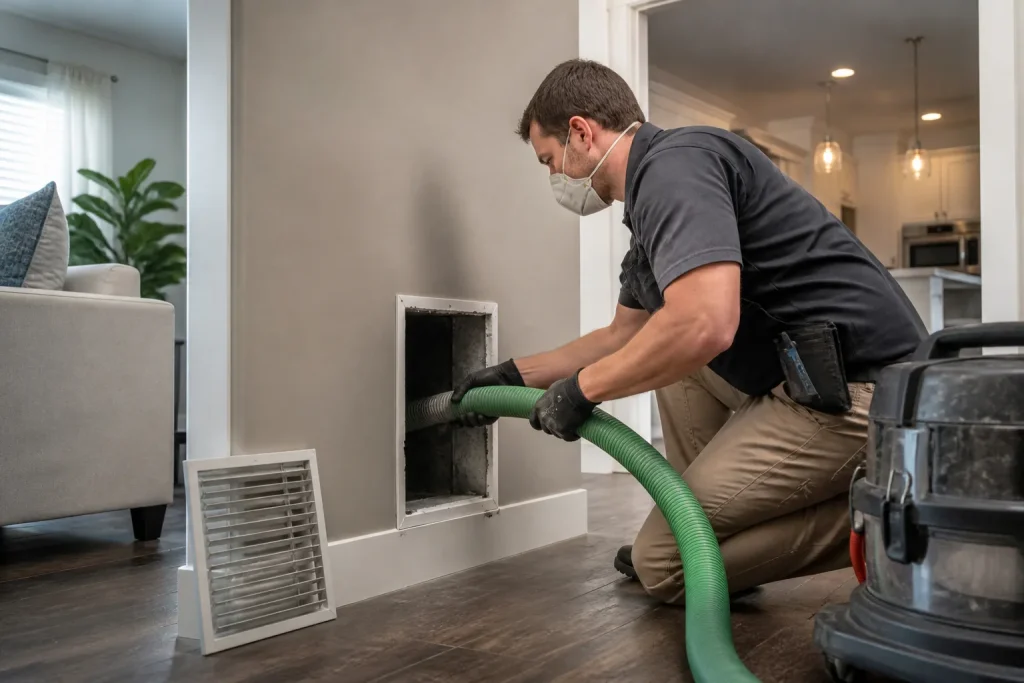
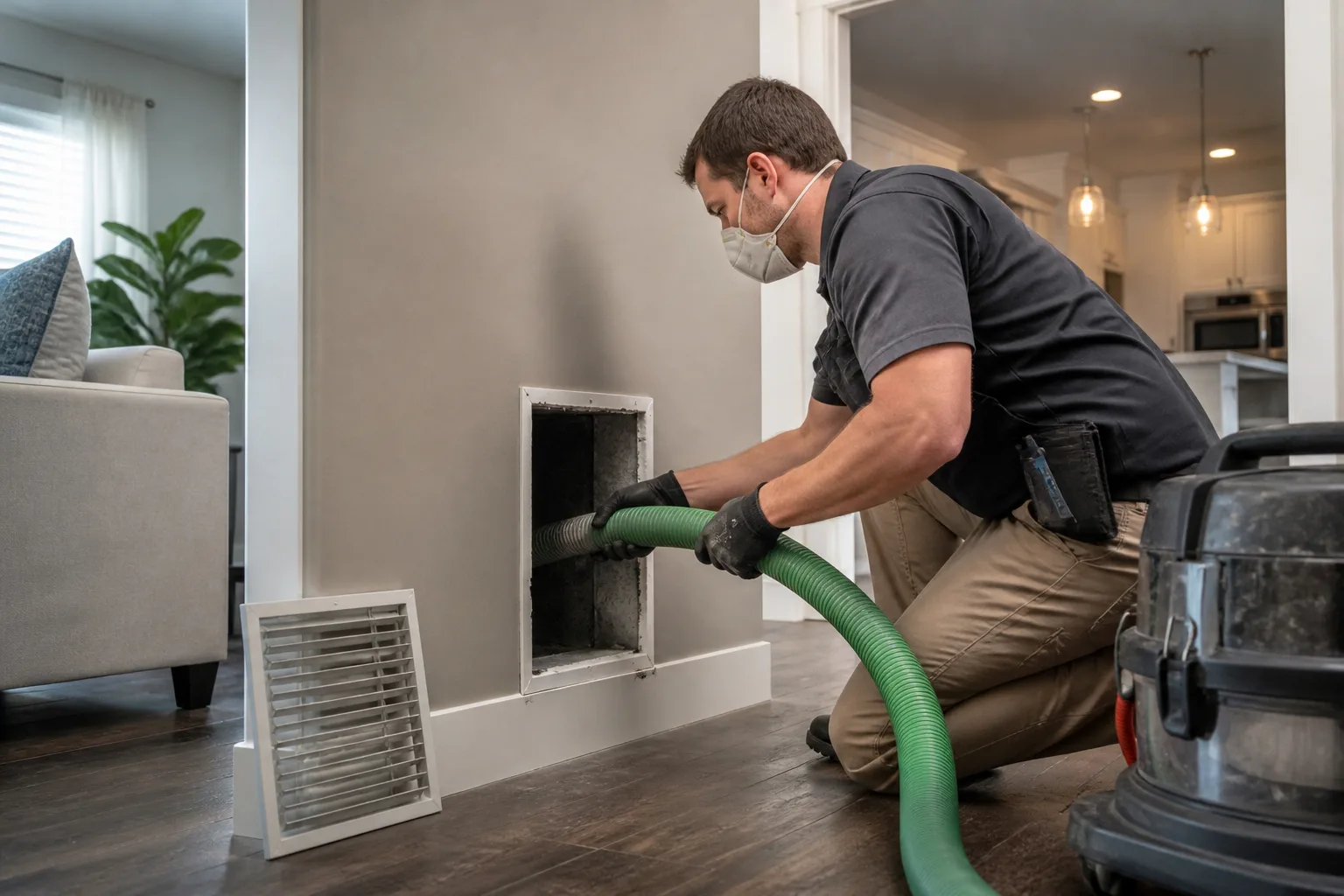
Standard air duct cleaning removes dust, pet hair, and general buildup. It’s a contact-clean process with a rotating brush head and a vacuum keeping pace – a Rotobrush system does it well when the technician knows what they’re doing. Post-fire and post-flood cleaning is a different procedure entirely.
Fire leaves oily soot on duct surfaces, and soot binds to metal and duct board in a way dust never does. Brush-and-vacuum alone can pull the loose material but leaves the residue, which keeps releasing odor into the supply air. A proper post-fire job includes mechanical cleaning, then a sanitizing or encapsulating application designed to lock smoke residue in place on the duct surface. Post-flood work adds an antimicrobial step and a moisture check, because applying any chemical to ductwork that’s still damp is a way to grow mold, not prevent it.
This is the work behind “Clean ducts are the start – sealed, repaired ducts are the finish.” A proper emergency response should also include air duct cleaning combined with HVAC cleaning when the coil, blower, or plenum has been exposed; cleaning the ducts without cleaning the unit that pushes air through them leaves the contamination source in place.
Insurance Documentation You Need From the Start
Filing a successful duct cleaning claim after fire, smoke, water, or pest damage comes down to documentation captured before, during, and after the work. Most denied claims fail because the homeowner cleaned first and documented second. Don’t clean before you photograph.
What you’ll need to file:
- Photos and video of the contamination before any cleaning, taken close enough to identify the material
- A written pre-cleaning assessment from the contractor describing the contamination category and the affected areas
- The written scope of work, with the equipment to be used (containment, HEPA, sanitizing agents) spelled out
- Post-cleaning photos and a written summary of the work performed
If the claim is tied to a fire or water event, your adjuster will want the assessment tied to that event. Ask the technician to be specific about cause in the written scope. We approach insurer communication as a working relationship – we can supply the documentation your adjuster needs, and you’re the one filing.
When to Call a Pro Instead of Waiting
If the smell is smoke, sewage, or dead animal, or if anyone in the household has asthma, allergies, or a compromised immune system, call now. Don’t run the system hoping it clears up. Don’t pull up registers and reach inside. Duct interiors aren’t a homeowner-maintained space, and small things dropped into a return can end up in the blower.
For a general “my ducts feel dirty but nothing’s wrong” situation, a scheduled appointment with a full-system assessment is the right move, not an emergency call. Routine cleaning, dryer vent cleaning, and post-cleaning air quality upgrades from Honeywell and Aprilaire products fall into that category. The Broomfield Air Duct Cleaning Pros team handles all five services – air duct cleaning, dryer vent cleaning, HVAC cleaning, duct repair and sealing, and air quality and sanitizing – under one engagement, so you’re not coordinating multiple contractors in the middle of a mess. Our technicians have up to 10 years of experience and use the same equipment commercial HVAC contractors trust.
Related services in Broomfield: If your ducts are tied to a failing dryer vent or a compromised HVAC unit, we can address all of it in one visit and leave the whole system sealed and clean.
The Bottom Line
In a real duct emergency, turn the system off, contain the affected zone, photograph everything, and call a provider who runs HEPA negative-air containment and can do a camera assessment. A strong odor is not an emergency; sewage in a return plenum, rodent intrusion, or post-fire soot is. Ask about equipment and certification before you dispatch anyone, and don’t clean before documentation if you plan to file a claim.
If you’re in Broomfield and need help, Broomfield Air Duct Cleaning Pros offers free estimates – call (877) 792-6623. We answer 24/7. Fast dispatch from 7am to 7pm, Sunday through Friday. One flat price per system agreed before work starts, before-and-after photos of your own ducts, and the same professional-grade equipment on every job.
Frequently Asked Questions
Cost depends on the contamination type and the size of the system, not on the time of day. Post-fire, post-flood, and sewage-contamination jobs require more containment, more equipment time, and a sanitizing or encapsulating step, so they run higher than routine cleaning. We don’t publish a number here because the written estimate from a pre-cleaning assessment is the price. Call (877) 792-6623 for an exact quote – estimates are free.
No. Running the blower in fan mode moves the contaminant through the whole duct network and into every room. In a fire or sewage situation, the fan is the problem, not the solution. Cut power to the system at the thermostat and contain the registers first.
A low quote usually means no negative-pressure containment, no HEPA equipment, no camera assessment, and a technician reaching into ducts with a shop vac. Cheaper quotes often leave contamination redistributed through the home. Ask what equipment they’re bringing and whether the price is per vent or per system. Call (877) 792-6623 if you want a flat per-system number with the equipment listed in writing.
For most Broomfield homes, every few years is enough, or sooner if a renovation, fire, rodent issue, or water event introduces contamination. Homes on the windy western edges near open space may need it more often because of dust intrusion. There’s no universal rule; a visual assessment answers it better than a calendar. Call (877) 792-6623 and we’ll help you decide whether you actually need it now.
Written by the team at Broomfield Air Duct Cleaning Pros.
Need Air Duct Cleaning Help?
Call Broomfield Air Duct Cleaning Pros - the local pro we connect you with is licensed and insured, with free written estimates in Broomfield.
(877) 792-6623