
Air Duct Cleaning: Repair or Replace? How Broomfield Homeowners Decide
Replacing every duct in the house when sealing would have fixed the problem is an expensive mistake. But sealing a system with fundamental design flaws just postpones the inevitable. The deciding factor usually isn’t the age of the ductwork, it’s what the static pressure readings tell you about how hard the air handler has to work to move air through it. Get that measurement, understand what it means, and you can walk into a contractor conversation knowing which answer actually fits your house in Broomfield.
Why Duct Age Is the Wrong Place to Start
Homeowners usually open the conversation with “the ducts are old, do they need replacing?” In our experience, age is the least useful number in the room. A well-sealed sheet metal trunk from decades back can perform better than a flex duct run installed a handful of years ago if that flex was poorly routed or crushed behind a joist.
What matters more is whether the ductwork can be made to perform. That means asking three practical questions:
- Is the layout capable of delivering the right airflow? Undersized trunks, too many sharp turns, or supply runs long enough to bleed off pressure all point to a design issue, not a cleaning issue.
- Is the leakage fixable in place? Small seam leaks, loose joints and pinholes are sealing jobs. Disconnected trunks, collapsed runs and rodent damage are physical repair jobs.
- Is the material still sound? The duct material determines how much life is left in the system. We cover that next.
When a system passes those checks, cleaning and sealing is the sensible spend. When it fails one or more, patching it up means paying twice. We approach this as a full-system conversation at air duct cleaning, and the diagnosis comes before the cleaning equipment rolls in.
The Static Pressure Test: The Measurement That Actually Decides
External static pressure (ESP) is the resistance the air handler pushes against as it moves air through the duct system, and it’s the single most useful number in the repair-or-replace decision. A technician should drill small test ports at the supply and return plenums and read total external static pressure with a digital manometer while the system runs at full fan speed.
Different air handlers have different rated maximums, and the manufacturer’s spec plate tells you what yours is rated for. What matters is the gap between the measured number and that rating. When measured ESP sits meaningfully above the nameplate maximum, the blower is working harder than it was designed to, airflow at the far registers drops, and the system’s efficiency and comfort both suffer. That elevated reading pulls the diagnosis toward undersealed or badly routed ductwork.
The static pressure reading also tells a technician whether sealing is likely to move the needle. If two-thirds of the overpressure traces to leaks at seams and joints, sealing is worth it. If it traces to a trunk that’s simply too small for the system, no amount of mastic closes that gap. We include this reading in every HVAC cleaning assessment because it reframes the whole job around actual performance rather than a visual once-over.
What the readings mean in plain terms
- Within rated spec: The layout is delivering what it can. Cleaning and light sealing keep it there.
- Slightly over spec: Leaks and dirty components are likely culprits. Seal and clean, then re-test.
- Well over spec: Something structural is wrong. Sealing alone won’t fix it, and the diagnosis moves to repair or replacement.
Duct Material Lifespan in Broomfield’s Climate
Broomfield’s climate swings hard. Attic temperatures in the summer and cold snaps in the winter put a lot of stress on the duct sections that run through unconditioned space, and material type determines how much punishment a system can take.
Fiberglass flex duct
Flexible duct is the most common material in newer residential construction. The inner liner is thin, and hot attic air over multiple summers hardens and cracks it. Rodents also favor it. Flex duct in an attic exposed to temperature extremes degrades noticeably faster than rigid sheet metal, and a system with ten to fifteen years on it is often at the point where the liner has started to fail. Crushed or pinched flex behind a joist or a dropped ceiling is a common finding and one of the biggest single causes of low airflow to distant registers.
Rigid sheet metal
Galvanized sheet metal handles heat and cold far better. Its useful life is usually limited by joint leakage and corrosion at the seams rather than the metal itself. A sheet metal trunk with solid seams and decent support often has decades of life left, and gets better with sealing rather than worse.
Flexible branch runs feeding a rigid trunk
This combination is where the hybrid decision gets made, and it’s the option many homeowners never hear about. The trunk stays. The branch runs that have degraded get replaced. We’ll come back to the math.
Sealing Versus Physical Repair: When Aeroseal Makes Sense
Aeroseal-style aerosol sealing is a genuinely useful tool, but it’s for a specific problem: distributed leaks across an otherwise functional duct system. The sealant is injected as a fog that finds and plugs gaps up to a certain size from the inside. When the static pressure test shows a system losing meaningful airflow to small leaks all over the network, this approach closes them from the inside without opening walls.
Where it isn’t the right call:
- Disconnected trunk or branch lines. A run that’s come loose at a takeoff is an open hole, not a leak. It needs to be physically reattached.
- Collapsed flex runs. No sealant restores a duct that’s been crushed shut.
- Rodent damage. Chewed sections need replacement, not a coating.
- Ductwork that’s falling apart at the seams. When the whole run lacks structural integrity, aerosol sealant is lipstick.
Physical repair and aerosol sealing aren’t competitors. A competent job on a failing system often uses both: reattach and replace the damaged sections, then seal the whole network with aerosol or hand-applied mastic so the newly solid system performs the way it should. Our Broomfield Air Duct Cleaning Pros team includes repair and sealing in the same visit as cleaning, which matters because a repaired duct doesn’t need a second crew to seal it.
Cost-to-Performance Math: When Sealing Beats Replacing
Homeowners often ask whether a sealing job is money well spent on an older system. The math makes the answer visible.
Say your ductwork is losing a meaningful share of its air through leaks (30% is a commonly cited figure for poorly sealed residential systems), and a sealing job cuts that to under 10%. The air handler has to move less air to deliver the same comfort at the registers, and the blower’s electrical draw and runtime drop accordingly. Over a service life of several seasons, that saving adds up against the sealing cost.
Now compare it against the alternative. A full duct replacement at typical pricing pushes that savings calculation out much further, and the new system still has to solve the fundamental problem of airflow and layout. If leakage is the problem, sealing wins the payback comparison. If the layout is the problem, replacement is the only honest answer.
Rough ranges to steady your budgeting, and these are estimates only, final price set by the written estimate:
- Aerosol sealing on a typical residential system: Often in the several-hundred-dollar range, depending on system size and leak extent.
- Full duct replacement on a standard home: Usually in the low thousands to upper thousands dollar range, varying widely with layout access and material.
- Hybrid (replace branch runs, retain and seal the trunk): Between the two, often the sharpest value on an older system.
The Hybrid Approach Most Homeowners Overlook
Full replacement or full seal-and-clean aren’t the only two choices. The hybrid option is usually the right one for a system where the trunk is solid but the branch runs have aged out.
Here’s the framework:
- Test static pressure. Note whether the shortfall traces to the trunk or the branches.
- Inspect the trunk for structural integrity. Solid sheet metal with typical seam leakage stays.
- Inspect each branch run. If flex ducts are crushed, chewed, or liner-degraded, replace them.
- Seal the retained trunk and all joints with mastic and, if the leakage calls for it, aerosol sealing.
- Re-test static pressure after the work. The number should come down.
This costs less than replacing the whole system, delivers most of the airflow and efficiency gain, and doesn’t throw away good sheet metal. It also gives the homeowner before-and-after photos and a verified post-work static pressure reading to confirm the work was actually done.
When to Call a Pro
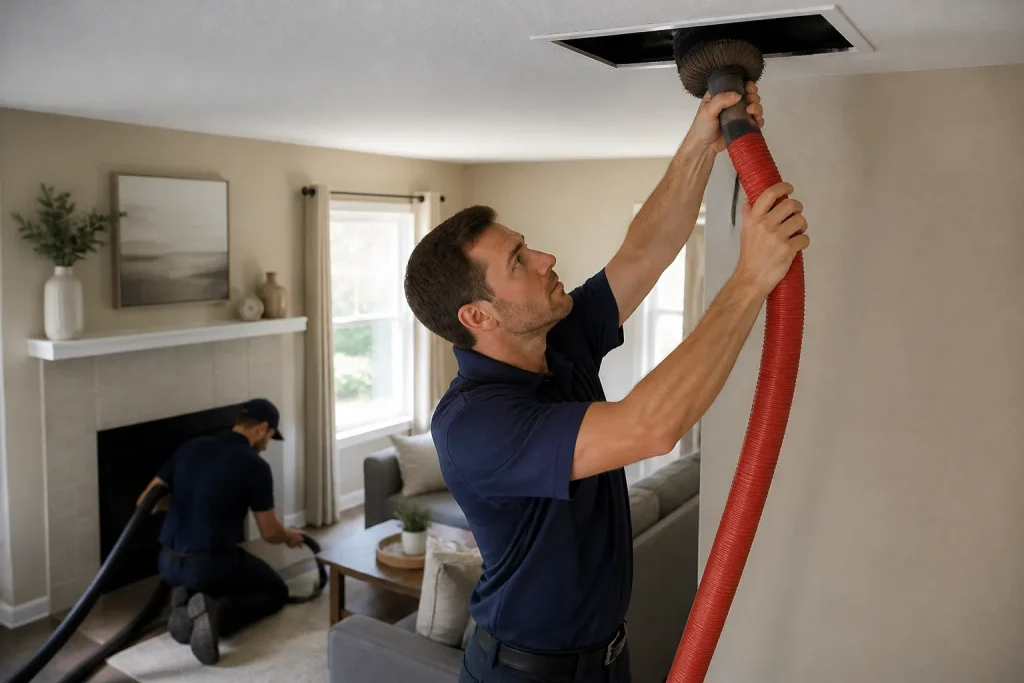
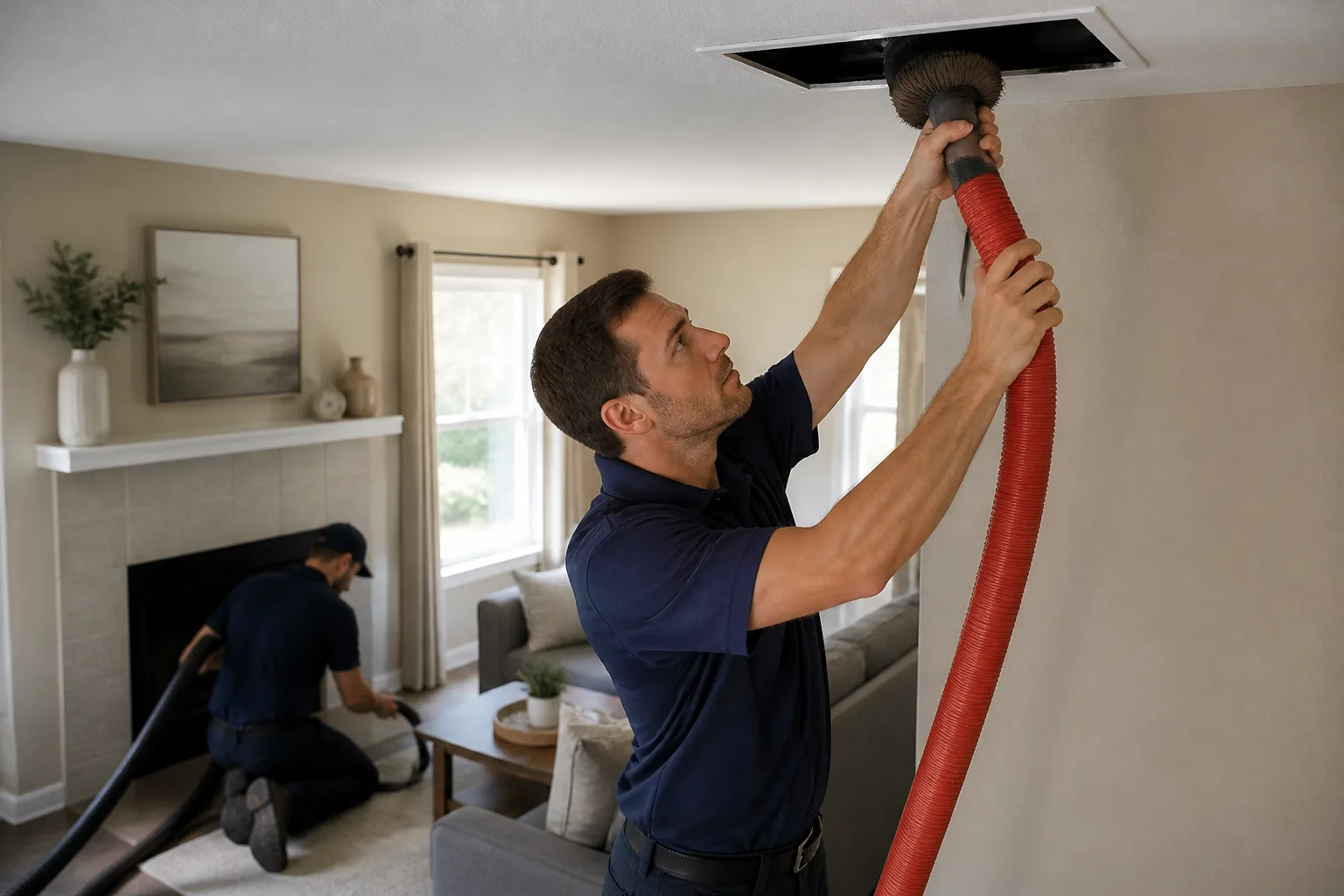
Static pressure testing, aerosol sealing and duct repair all involve sealed systems, calibrated instruments and access to plenums that need to be opened correctly and closed properly afterward. This isn’t a homeowner task, and the diagnosis is only as good as the equipment behind it. Professional gear matters here: our technicians use Rotobrush for interior contact cleaning, Nikro HEPA units to hold negative pressure so dislodged debris doesn’t drift into living space, and Abatement Technologies containment gear on every job so the containment is right while the work is underway. A homeowner with a shop vac and a flashlight can spot obvious damage, but the readings that actually settle the repair-versus-replace question come from proper instruments.
Related services in Broomfield: if the inspection turns up a clogged dryer vent while we’re on site, we handle dryer vent cleaning as part of the same visit. That’s five services under one roof, so you’re not chasing three contractors to cover the same duct system.
The Bottom Line
Repair or replace isn’t a decision about your ductwork’s age. It’s a decision about whether the existing layout can be made to perform with sealing and repair, or whether the geometry is the problem. Ask for a static pressure reading. Match the fix to the diagnosis: aerosol sealing and mastic for distributed leaks, physical repair or replacement for collapsed, disconnected or damaged runs, and a hybrid approach when the trunk is sound but the branches aren’t. Then ask to see the post-work readings and before-and-after photos before you write a check.
If you’re in Broomfield and need help, Broomfield Air Duct Cleaning Pros offers free estimates. Our technicians have up to 10 years of experience, we work with Rotobrush, Nikro and Abatement Technologies equipment on every job, and we carry Honeywell and Aprilaire products for air-quality upgrades once the mechanical work is done. Call (877) 792-6623. We answer 24/7. Fast dispatch from 7am to 7pm, Sunday through Friday.
Frequently Asked Questions
Typical residential duct cleaning runs in the several-hundred-dollar range, with sealing and repair priced separately based on what the static pressure test reveals. No two homes are the same, so the written estimate is what sets your final price. We give one flat price per system agreed before work starts, so there’s no surprise invoice once the technician is on site. Call (877) 792-6623 for a free estimate.
Low quotes often reflect a surface clean rather than a full-system clean: a shop vac and a quick pass through the registers without negative pressure containment, static pressure testing or sealing. That’s not the same job, and it shows up later as dust drifting back into the house or a system that still underperforms. Ask what equipment they’ll use, whether they measure static pressure, and whether they can show before-and-after photos. Call (877) 792-6623 if you want an estimate that spells out the process.
Ask for before-and-after photos of your own duct interiors and, for any sealing or repair work, post-work static pressure readings. A contractor comfortable with those requests is one worth hiring. If a quote comes without either, that’s a conversation to have before the job, not after. Call (877) 792-6623 for a free estimate that includes the diagnosis.
Most homes in Broomfield do well with cleaning every few years, and some need it sooner after remodeling, a rodent problem, or a visible dust issue at the registers. Sealing and repair timelines follow the static pressure reading rather than the calendar. There’s no universal schedule, but a system that passes its static pressure test on cleaning doesn’t need to be touched for a while. Call (877) 792-6623 for a free estimate and a straight answer on timing.
Written by the team at Broomfield Air Duct Cleaning Pros.
Need Air Duct Cleaning Help?
Call Broomfield Air Duct Cleaning Pros - the local pro we connect you with is licensed and insured, with free written estimates in Broomfield.
(877) 792-6623